Tiny Miracles Rewrite India’s Neonatal History: 23-Week Preemies Defy Science, Survive Without Major Complications
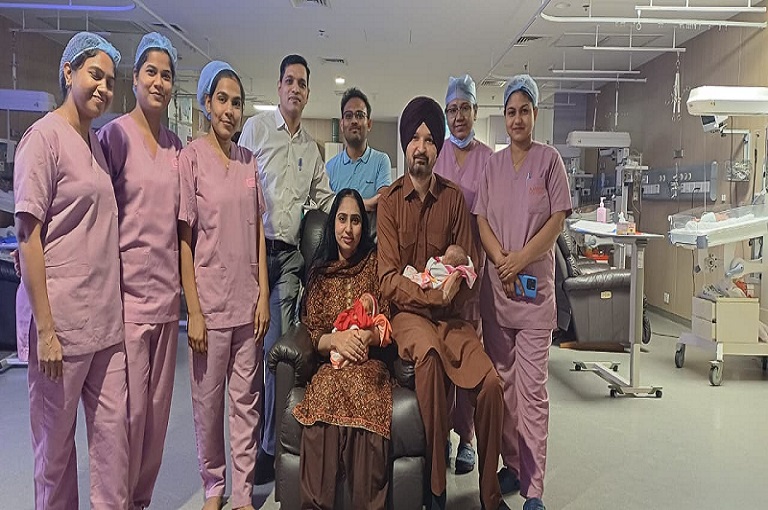
Against every medical odd, Dr. Hemant Sharma and his team at Amrita Hospital, Faridabad, achieve India’s first intact survival of 23 +5-week and two 23+6-week preterm babies — proving that hope, science, and dedication can create miracles.
Faridabad/ New Delhi 16 Oct 2025: In a ground-breaking medical triumph that challenges established limits of neonatal survival, Amrita Hospital, Faridabad, has achieved what leading centres across India deemed impossible — the intact survival of 23-week premature babies, each weighing barely 500–600 grams at birth. These are among the youngest and smallest babies ever to survive in India, leaving the medical fraternity in awe.
The first case — a 23-week and 5-day-old baby boy weighing just 550 grams — was born in a small nursing home and initially declared non-viable. Devoid of oxygen and glucose for nearly 30 minutes, he astonishingly continued to breathe, prompting his family to rush him to Amrita Hospital. Over a 90-day NICU stay, he grew steadily to a robust 2200 grams, discharged with completely normal brain and lung function — an outcome rarely witnessed even in advanced neonatal centers.
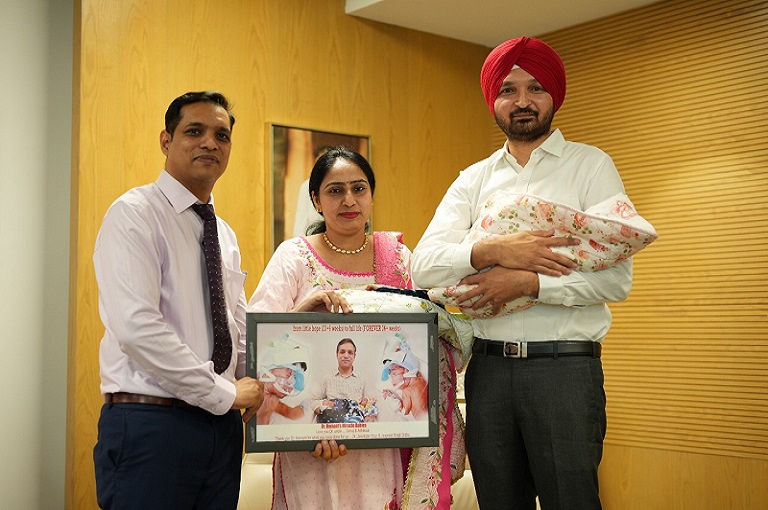
Just months later, another milestone was set. 23+6 week-old twin girl & boy, born to a 41-year-old mother with a previous preterm loss, became the youngest surviving twins in India without any neurological or pulmonary complications.
Despite being on the edge of viability — where global survival averages remain bleak — both infants beat the odds.
- Twin 1 (500 g) required only 1.5 days of mechanical ventilation and recovered fully after minor eye laser therapy for ROP.
- Twin 2 (630 g) never needed mechanical ventilation at all and today breathes and thrives naturally — a medical rarity for 23-weekers worldwide. No Retinopathy of Prematurity (ROP).
Their story is not just survival but intact survival — free from chronic lung disease (BPD) or brain injury (IVH) — the holy grail of neonatology.
Under the leadership of Dr. Hemant Sharma, the Amrita NICU team employed a combination of world-class neonatal science and compassionate care. The babies were nurtured in womb-like incubator environments, maintained at 80% humidity to preserve body heat and water. Every sound and flash of light was controlled to simulate natural fetal sleep rhythms.
Kangaroo care — where the mother holds the baby on her chest — played a critical role in healing, bonding, and stabilizing the infants.
Only 48 hours of mechanical ventilation (compared to an average of 2-3weeks at 23 weeks) was needed for the first case — a remarkable testament to the team’s mastery of preterm physiology.
Feeding protocols were aggressively yet safely advanced, with full mother’s milk achieved in just six days — less than half the expected timeline.
“For decades, 23 weeks was considered the ‘gray zone of survival,’ even in developed countries. Today, we’ve proven that with scientific precision, deep compassion, and family participation, miracles can be reproducible,” said Dr. Hemant Sharma, Senior Consultant, Neonatology, Amrita Hospital, Faridabad. “These babies have not just survived; they have thrived — intact, infection-free, and developmentally normal. It’s a landmark moment for Indian neonatology”, he added.
Patient said: “When doctors told us there was no hope, our hearts broke twice — once for our baby’s size and again for the uncertainty. But the Amrita team gave us faith when we had none left,” said the mother of the 23-week twins. “Seeing both our babies in our arms today, healthy and smiling, feels nothing less than touching the hand of God.”
Before these cases, hardly any hospital in India— had recorded intact survival of 23-week or younger twin preemies. Amrita Hospital’s outcomes now position it as a national leader in neonatal innovation and compassionate critical care.
As the twins and the 23-week-old “nano-prime” brother & sister continue to grow normally, their survival not only redefines the limits of life but also ignites a new era of medical possibilities — where science meets faith, and miracles breathe again.
About The Author