D Gukesh Defeats Hikaru Nakamura – Wins Hearts with Calmness, Class, and True Sportsmanship

Gukesh’s Historic Victory That Shook the Chess World
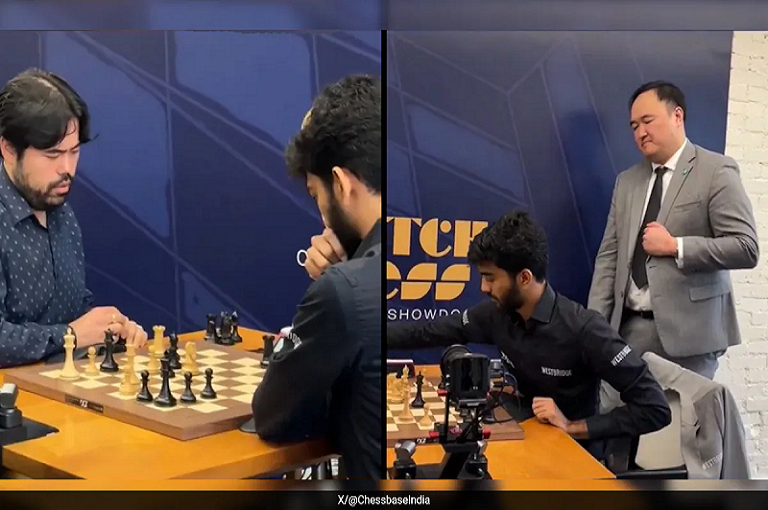
World Chess Champion D Gukesh once again captured global attention — not only with his brilliant gameplay but also with his composure and grace. In the Clutch Chess Champions Showdown 2025, held in St. Louis, USA, the young Indian Grandmaster defeated American star Hikaru Nakamura in the rapid format, sealing a memorable win.
But this wasn’t just another match — it was a moment of poetic justice. A few weeks earlier, during an exhibition match, Nakamura had controversially picked up Gukesh’s king piece and thrown it toward the audience after defeating him, sparking a major uproar across social media.
This time, Gukesh gave his reply — not through words, but through quiet brilliance and perfect sportsmanship. His calm reaction after the victory won millions of hearts around the world.
Clutch Chess Showdown 2025 – Strategy Meets Psychology
The 2025 edition of the Clutch Chess Showdown featured the world’s elite players. In this rapid-format duel, both Gukesh and Nakamura displayed their trademark intensity and precision.
In Round 2, Game 1, Gukesh played with the black pieces and executed a perfectly calculated plan. While Nakamura is known for his hyper-aggressive style, Gukesh relied on strategic control, patience, and flawless defense.
From the opening itself, Gukesh neutralized Nakamura’s initiative, gradually taking over the center of the board. His knight and bishop coordination in the middlegame forced Nakamura into a defensive shell. In the endgame, Gukesh converted his advantage with surgical precision, leaving no room for escape.
The “King Throw” Controversy – A Moment That Divided Chess Fans
Just weeks earlier, Hikaru Nakamura had defeated Gukesh in a casual exhibition match. After the win, Nakamura lifted Gukesh’s king and theatrically tossed it into the crowd, an act that went viral online as the “King Throw Controversy.”
The gesture drew heavy criticism from many chess legends and fans, who called it “disrespectful” and “unsportsmanlike.” Others claimed it was merely an entertainment stunt designed to engage viewers.
Nakamura later defended himself, saying the act was pre-planned and meant only for fun — but the damage was done. Many saw it as an unnecessary showboating move against the newly crowned world champion.
Gukesh’s Calm Revenge – A Lesson in Grace and Dignity
Throughout the controversy, D Gukesh remained silent. He neither retaliated nor commented publicly. Instead, he did what he does best — focus on the board.
And when the rematch came, he let his chess do the talking. After defeating Nakamura this time, Gukesh showed no reaction — no celebration, no taunt. He simply reset the chessboard, arranged the pieces neatly, and shook Nakamura’s hand.
That single moment spoke louder than any words could.
The video of his calm gesture went viral across platforms like X (Twitter), YouTube, and Instagram, earning praise from fans and sports icons alike.
Fans flooded the internet with comments such as:
- “Gukesh didn’t just win a game — he won respect.”
- “Nakamura threw a king, Gukesh threw silence — and silence hit harder.”
- “That’s what true champions are made of.”
Social Media Melts Over Gukesh’s Gentlemanly Conduct
The hashtag #GukeshVsNakamura began trending globally. Millions watched the video of Gukesh’s composed reaction, praising him for setting an example of sportsmanship and humility.
Chess commentators called it “the classiest revenge ever.”
Sports fans beyond the chess community shared the clip, calling it “a masterclass in grace under pressure.”
Even those who initially defended Nakamura’s earlier act admitted that Gukesh’s calm behavior had completely turned the narrative.
Tactical Brilliance – How Gukesh Outplayed the American Grandmaster
From a technical standpoint, Gukesh’s play was near flawless.
He opted for a Caro-Kann-like structure instead of his usual Sicilian defense, instantly neutralizing Nakamura’s opening attack.
In the middlegame, Gukesh’s precise positioning restricted Nakamura’s mobility. His central pawns created long-term pressure, while his rooks dominated open files.
In the final phase, a subtle pawn push forced Nakamura into zugzwang — a position where every move worsens your situation. Within a few moves, the American was forced to resign.
It was a win not just of skill, but of patience, preparation, and psychological control.
Sportsmanship Triumphs Over Showmanship
The world has seen countless rivalries in sports — but few end with such dignity.
D Gukesh proved that the best response to arrogance is excellence, and that true champions don’t need theatrics to make a statement.
His calm demeanor reminded fans of the golden era of chess — of legends like Viswanathan Anand, Anatoly Karpov, and José Capablanca — players who believed in the quiet power of respect.
Gukesh didn’t raise his voice, didn’t gloat, didn’t celebrate. Yet the message was clear:
“You can throw a king, but you can’t shake a true champion.”
Nakamura’s Reaction – Words of Respect After Defeat
After the match, Hikaru Nakamura acknowledged Gukesh’s brilliance.
He said, “Gukesh played incredibly well. He’s a phenomenal player and a true world champion. His composure is inspiring.”
While he again mentioned that the earlier “king throw” was for entertainment, fans interpreted his tone as one of respect — perhaps even regret.
The Rise of D Gukesh – India’s Young Chess Sensation
At just 19 years old, D Gukesh has achieved what few could even dream of — becoming the World Chess Champion and one of the youngest to do so.
Born in Chennai, Tamil Nadu, Gukesh represents the new generation of Indian chess, following the legacy of Viswanathan Anand. His achievements have inspired a new wave of interest in chess across India.
But more than his rating or titles, it’s his temperament that sets him apart. His ability to stay calm under pressure has become his trademark — and this match against Nakamura cemented that reputation forever.
Why This Win Matters Beyond the Chessboard
This victory wasn’t just about revenge or redemption. It was about redefining what it means to be a champion.
In an era where emotions often take over sports, Gukesh reminded everyone that true strength lies in restraint.
Where some players seek viral moments, he created one naturally — through quiet dignity.
His behavior has been hailed by fans and analysts alike as a lesson for young athletes everywhere — that success is not only about winning but about how you carry yourself in victory and defeat.
Conclusion – When Silence Speaks Louder Than Words
D Gukesh’s victory over Hikaru Nakamura will go down in history not merely for the result but for the message it carried.
He showed that grace can conquer arrogance, and that a calm mind is the most powerful weapon on the chessboard.
Nakamura threw a king.
Gukesh restored the kingdom.
With a simple gesture, he reminded the world:
“A true champion doesn’t need to shout. His moves speak for him.”
About The Author