Flights to US and Europe Disrupted After Turbulence and Airspace Restrictions Over Iran
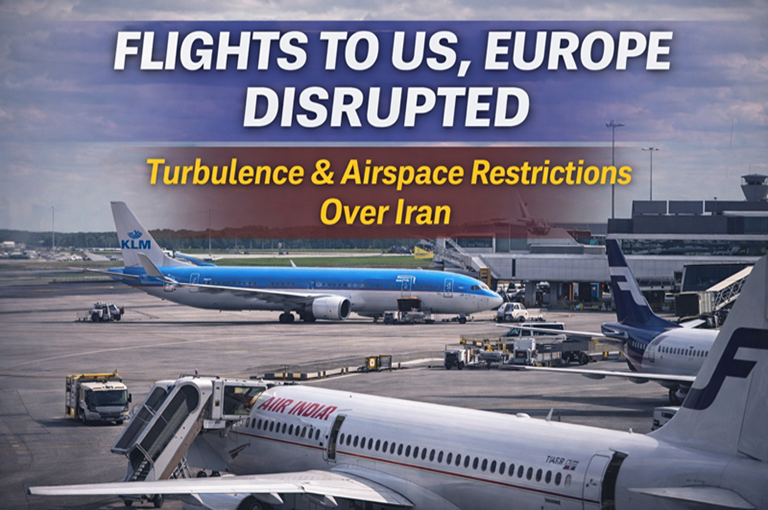
International air travel between Asia, Europe, and the United States has faced major disruptions after turbulence and sudden airspace restrictions over Iran forced airlines to cancel, delay, or reroute flights. Several long-haul services were affected as Iran temporarily closed parts of its airspace amid heightened regional tensions, triggering widespread operational challenges for global carriers.
Iran’s airspace is a crucial corridor for flights connecting South Asia with Europe and North America. Any disruption in this region has an immediate ripple effect on international aviation, leading to longer flight times, higher fuel consumption, and inconvenience for thousands of passengers.
Sudden Airspace Closure Impacts Global Routes
According to airline officials and aviation trackers, Iran briefly shut its airspace during a period of increased military and political tension. Although the closure lasted only a few hours, the timing significantly affected overnight and early-morning international flights, particularly those travelling from India to Europe and the US.
During the closure, airlines were barred from overflying Iranian territory, forcing pilots and flight planners to make quick decisions. Some flights were diverted mid-air, while others were delayed or cancelled before departure due to uncertainty over safe routing.
Even after Iran reopened its airspace, many airlines continued to avoid the region as a precaution, citing safety concerns and advisories issued by international aviation authorities.
Airlines Cancel and Reroute Flights
Several Indian and international airlines were impacted by the disruption. Air India cancelled multiple long-haul flights to the United States, including services to New York and Newark, as aircraft could not safely operate without passing through Iranian airspace.
Low-cost carrier IndiGo also reported disruptions to its international services, particularly flights to Europe, Turkey, and Central Asia. The airline said that some routes were rerouted via longer paths, while others experienced significant delays due to airspace congestion elsewhere.
European carriers such as Lufthansa, Air France, British Airways, and Finnair also adjusted flight paths, opting to avoid Iranian and neighbouring airspace. These changes increased travel time by up to several hours on certain routes.
Why Iran’s Airspace Is So Important
Iran lies at the crossroads of key aviation routes linking Asia, Europe, and North America. Flying over the country allows airlines to save fuel and reduce flight duration. When this airspace becomes unavailable, aircraft must take longer detours over countries like Saudi Arabia, Iraq, Central Asia, or even parts of Africa, depending on the destination.
These alternate routes not only extend flight time but also increase fuel costs, crew duty hours, and overall operational expenses. Airlines often struggle to adjust schedules quickly, leading to cancellations and missed connections for passengers.
Turbulence and Safety Concerns
In addition to airspace restrictions, pilots reported unusual turbulence in the region, further complicating flight operations. While turbulence itself is a common phenomenon, it becomes more challenging when combined with restricted routing options and crowded alternate airspace.
Aviation safety experts note that airlines prioritise passenger and crew safety above all else. When geopolitical tensions rise, even the possibility of risk is enough for airlines to reroute flights, especially on long-haul journeys.
Several aviation regulators have advised carriers to remain cautious while operating near conflict-prone zones, reinforcing the decision of many airlines to avoid Iranian airspace even after it reopened.
Impact on Passengers
The disruptions left thousands of passengers stranded at airports or facing long delays. Some travellers reported waiting several hours for updates, while others had to rebook flights or accept alternative routes with extended travel times.
Airlines offered refunds, rebooking options, or accommodation in some cases, but the sudden nature of the disruptions made it difficult to manage the situation smoothly. Travel experts have advised passengers flying to the US or Europe to closely monitor flight status updates and remain flexible with travel plans.
Broader Effect on Global Aviation
The incident highlights how sensitive global air travel is to geopolitical developments. With key air corridors frequently affected by regional tensions, airlines are increasingly forced to redesign routes, sometimes at short notice.
Such disruptions can also impact airfares, as increased fuel costs and longer flight durations may eventually be passed on to consumers. Industry analysts warn that repeated airspace closures in the Middle East could put additional strain on airlines already dealing with rising costs.
What Lies Ahead
While Iran’s airspace has reopened, uncertainty remains. Many airlines continue to monitor the situation closely and may maintain alternative routing until regional stability improves. Aviation authorities are expected to issue further guidance if tensions escalate again.
For now, passengers travelling between Asia, Europe, and the United States are advised to check flight schedules regularly and allow extra time for long-haul journeys. As global aviation remains closely tied to geopolitical stability, even brief disruptions can have far-reaching consequences.
🔹 Key Highlights
- Flights to the US and Europe disrupted due to Iran airspace issues
- Airlines forced to cancel, delay, or reroute long-haul services
- Increased flight time and fuel costs due to longer alternate routes
- Passengers advised to monitor flight updates closely
About The Author