Fabiano Caruana Defeats R Praggnanandhaa in Grand Chess Tour Finals 2026, Takes 6 0 Lead
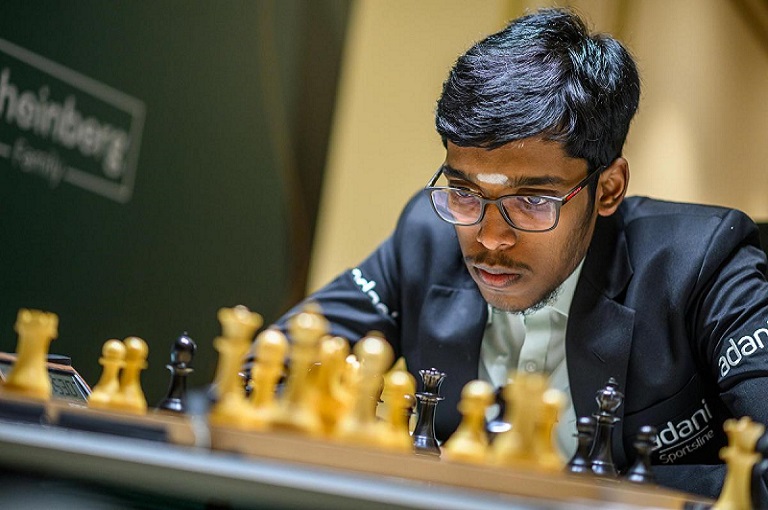
A Crucial 28th Move Error Changes the Entire Game
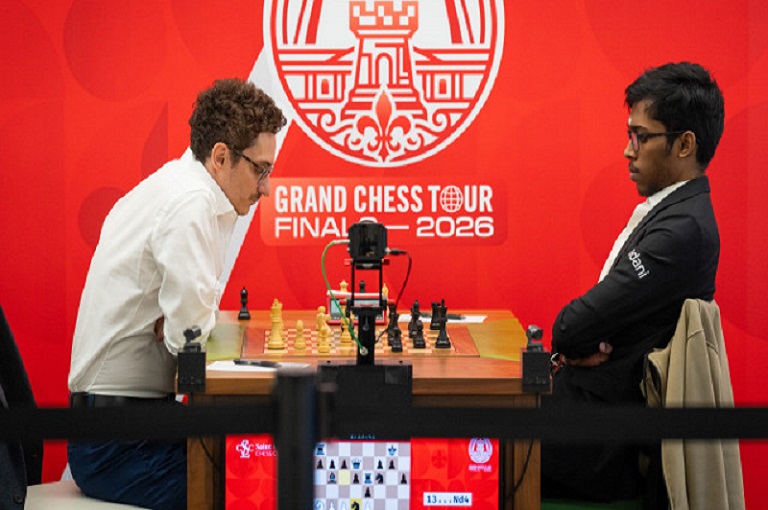
The Grand Chess Tour Finals 2026 title battle in St Louis has taken a dramatic turn as American Grandmaster Fabiano Caruana defeated Indian star R Praggnanandhaa in the first classical game of the final. Caruana secured a commanding 6 0 lead after capitalizing on a crucial mistake by Praggnanandhaa during the later stages of the game.
The encounter remained remarkably balanced for a long period. Both players demonstrated excellent preparation and careful positional play, with neither side able to establish a decisive advantage. Praggnanandhaa looked comfortable for much of the game and successfully neutralized Caruana’s early ideas.
However, the situation changed dramatically around the 28th move. Praggnanandhaa made an inaccurate decision that gave Caruana the opportunity he had been waiting for. The American Grandmaster immediately recognized the weakness, increased the pressure and converted his advantage with impressive precision.
The victory gives Caruana an important psychological advantage in the championship battle. Praggnanandhaa must now find a way to respond strongly in the second classical game.
Caruana Shows Patience and Precision
The first classical game was a perfect example of why patience is one of the most important qualities in elite chess. Caruana did not force the position when there was no clear advantage available.
After the game, Caruana explained that he also did not see any significant advantage for himself for much of the encounter. Around the 26th move, he was primarily trying to improve and stabilize his position rather than forcing an immediate breakthrough.
That approach eventually paid off.
Instead of taking unnecessary risks, Caruana maintained pressure and waited for Praggnanandhaa to make a mistake. When the Indian Grandmaster finally slipped, Caruana responded immediately and accurately.
His ability to transform a small positional opportunity into a winning advantage highlighted his tremendous experience at the highest level of competitive chess.
Praggnanandhaa’s 28th Move Becomes the Turning Point
For Praggnanandhaa, the biggest disappointment was that he had played a strong game for a considerable period before the critical mistake.
The position had remained balanced, and the Indian player appeared capable of holding his own against one of the world’s most experienced Grandmasters. But elite chess is often decided by a single moment.
The inaccurate 28th move gave Caruana the opening he needed. Once Caruana obtained a clear advantage, he did not allow Praggnanandhaa to recover.
The American player activated his pieces, increased the pressure and gradually forced the Indian Grandmaster into a difficult defensive position. From that point, Caruana’s technique was extremely impressive.
The game underlined an important reality of top level chess. Even when a player has defended successfully for hours, one inaccurate move can completely change the result.
Caruana Wins a Classical Game at the Grand Chess Tour Finals After Eight Years
The victory was particularly significant for Caruana because he said it was his first classical win at the Grand Chess Tour Finals since 2018.
After gaining the six point advantage, Caruana acknowledged the importance of the next classical encounter, especially because he would have the black pieces. If he can successfully navigate that game, his position in the championship battle will become considerably stronger.
Caruana’s experience, calculation and ability to remain calm under pressure have once again become major strengths in the final.
The six point lead also allows him to approach the next game with greater strategic flexibility. Rather than taking unnecessary risks, he can focus on maintaining control and preventing Praggnanandhaa from gaining momentum.
Praggnanandhaa Faces a Major Comeback Challenge
The defeat puts Praggnanandhaa under significant pressure, but the match is not over.
The young Indian Grandmaster has established himself as one of the most exciting players in world chess and has repeatedly demonstrated his ability to compete against the strongest names in the game.
His immediate challenge will be to put the first game behind him and approach the next encounter with a fresh mindset.
A strong result in the second classical game could completely change the momentum of the final. Praggnanandhaa will need to improve his accuracy in critical positions, manage his time carefully and avoid giving Caruana another opportunity to seize control.
The psychological battle will be just as important as the moves on the board.
Vincent Keymer and Wesley So Play Out a Fighting Draw
The third place match also produced an exciting contest. Vincent Keymer and Wesley So played to a draw in their first classical game, leaving the score tied at 3 3.
The encounter featured a complicated position in which both players demonstrated excellent defensive and tactical skills. Neither player was able to establish a decisive advantage, and the game eventually reached a rook endgame.
Both Keymer and So handled the final phase with precision, and the contest ended peacefully.
For Keymer, the new match also offered an opportunity to reset mentally after his previous defeat against Praggnanandhaa. He indicated that beginning a new match helped him regain focus.
Fatigue Becomes a Growing Factor in the Tournament
The Grand Chess Tour Finals is an extremely demanding competition. Players have to deal with long classical games, intense preparation and the mental pressure of competing against elite opponents.
Fatigue can become a significant factor as the tournament progresses.
Keymer acknowledged that players are feeling the effects of a long tournament. Maintaining concentration for several hours at the chessboard requires enormous mental and physical energy.
At the highest level, even a brief lapse in concentration can have serious consequences. Praggnanandhaa’s mistake in the first classical game serves as another reminder of how important sustained focus is in elite chess.
Second Classical Game Becomes Crucial
The second classical game between Caruana and Praggnanandhaa was scheduled for August 26 at 10 30 PM Indian Standard Time.
The encounter is extremely important for both players.
For Caruana, the objective is straightforward. He needs to protect his advantage and avoid giving Praggnanandhaa an opportunity to build momentum.
For Praggnanandhaa, the situation is more urgent. He needs a strong result to reduce the deficit and keep his championship hopes alive.
A victory for Praggnanandhaa could dramatically change the atmosphere around the final. A solid result for Caruana, meanwhile, would put the American Grandmaster in an even stronger position heading into the faster formats.
Rapid and Blitz Could Add More Drama
The tournament format also means that the battle does not end with the classical games.
Rapid and blitz contests are scheduled after the classical phase. These formats require players to make decisions much faster, creating a completely different competitive environment.
For Praggnanandhaa, the faster formats could provide an important opportunity to fight back. His tactical ability and quick calculation can become major weapons when there is less time on the clock.
However, Caruana’s experience in rapid and blitz chess also makes him a dangerous opponent.
The faster formats could therefore produce some of the most exciting moments of the entire Grand Chess Tour Finals.
Huge Prize Money Adds to the Stakes
The Grand Chess Tour Finals 2026 is taking place in St Louis from August 22 to August 27.
The tournament features a total prize fund of 450000 dollars, with the champion set to receive 200000 dollars.
Beyond the substantial financial reward, the tournament carries enormous prestige. Competing successfully against the world’s leading Grandmasters provides valuable recognition and strengthens a player’s standing among the global chess elite.
For both Caruana and Praggnanandhaa, the final represents an opportunity to finish the tournament with one of the biggest achievements of the season.
Caruana’s Powerful Start Changes the Championship Battle
Caruana’s victory in the opening classical game has completely changed the dynamics of the Grand Chess Tour Finals 2026 title match.
The American Grandmaster now holds a six point advantage and has demonstrated that he can remain patient until the smallest opportunity appears.
Praggnanandhaa, meanwhile, will have to respond under pressure. His first game showed that he can compete with Caruana for long stretches, but the decisive mistake ultimately proved costly.
The key question now is whether the Indian Grandmaster can recover mentally and produce a powerful response.
Caruana has experience and momentum on his side. Praggnanandhaa has youth, fighting spirit and the ability to create complications.
That combination makes the Grand Chess Tour Finals 2026 title battle one of the most compelling chess contests to watch. A single brilliant performance from Praggnanandhaa could bring the match back to life, while another strong result for Caruana could put the championship firmly within his reach.
The opening game has given Caruana a major advantage, but the final battle is far from over. All eyes now turn to the next stage of the contest, where every move could have a massive impact on the race for the Grand Chess Tour title.
About The Author




1 thought on “Fabiano Caruana Defeats R Praggnanandhaa in Grand Chess Tour Finals 2026, Takes 6 0 Lead”