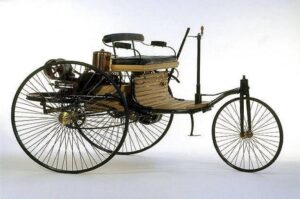
The First Petrol Car Had Just 0.75 HP and Three Wheels: How Karl Benz Revolutionised the World of Transportation
Today, millions of cars travel across roads worldwide. From petrol and diesel vehicles to hybrid and electric cars, the automobile industry has undergone a remarkable transformation. Modern cars come equipped with powerful engines, advanced safety features, smart technology and luxurious interiors. But did you know that the world’s first practical petrol-powered automobile had just 0.75 horsepower and only three wheels?
This small vehicle laid the foundation for a transportation revolution that changed the way people travelled forever. The credit for this historic invention goes to German engineer Karl Benz, who developed the Benz Patent-Motorwagen in 1885. On January 29, 1886, he filed a patent application for his revolutionary vehicle, marking a major milestone in automobile history.
Behind this remarkable achievement were years of engineering experiments, financial struggles and unwavering determination. His wife, Bertha Benz, also played a crucial role in supporting his dream and demonstrating the practical capabilities of the automobile. Here is the fascinating story of Karl Benz and how his groundbreaking invention transformed the automotive world.
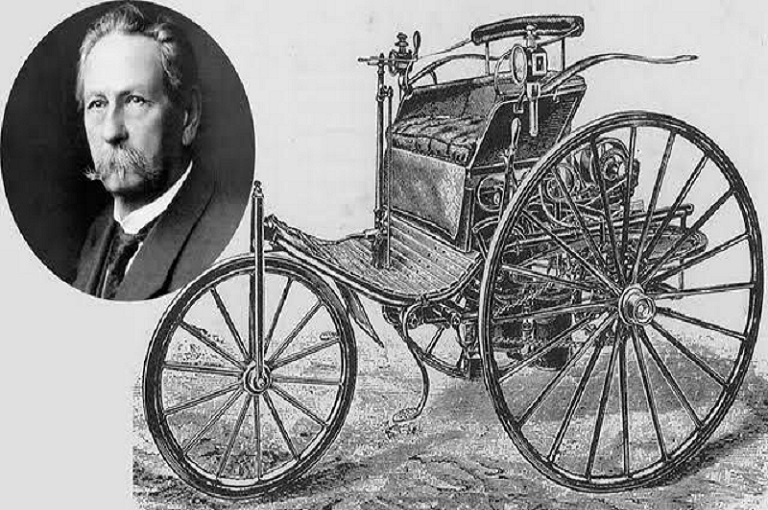
Who Was Karl Benz? The Engineer Who Dreamed of Motorised Transportation
Karl Benz was born on November 25, 1844, in Karlsruhe, Germany. His full name was Carl Friedrich Benz. His father, Johann Georg Benz, worked as a locomotive driver but passed away when Karl was very young. Following his father’s death, his mother took responsibility for raising him and supporting his education.
From an early age, Benz showed a strong interest in machines, technology and engineering. He was fascinated by how mechanical systems worked and enjoyed understanding the science behind different machines.
At just 15 years old, he enrolled at the Karlsruhe Polytechnic School, where he pursued mechanical engineering. He completed his engineering education in 1864.
After graduating, Benz worked with several engineering and manufacturing companies, gaining valuable practical experience. His early professional career involved working with machinery, metalworking and industrial equipment.
These experiences helped him develop the technical knowledge that would eventually lead to one of the most important inventions in transportation history.
Karl Benz Faced Financial Difficulties Before His Historic Invention
After gaining professional experience, Karl Benz decided to establish his own business. In August 1871, he founded a mechanical workshop in Mannheim with business partner August Ritter.
However, the business did not perform as expected. Financial difficulties soon emerged, threatening his ability to continue his engineering experiments.
During this challenging period, his wife, Bertha Benz, provided crucial financial support. She used money from her inheritance to help rescue her husband’s struggling business.
Bertha was not just a supportive partner but also someone who believed strongly in Karl’s technical abilities and vision. Her financial contribution allowed him to continue experimenting with engines and mechanical systems.
The couple had married in 1872, and Bertha remained an important part of Karl’s professional journey. Her confidence in his ideas played a significant role in helping him overcome financial obstacles.
1879: Karl Benz Successfully Developed His First Gas Engine
For several years, Karl Benz worked on developing a compact internal combustion engine that could eventually power a vehicle.
At the time, steam engines were already being used in transportation and industrial machinery. However, developing a smaller and lighter engine suitable for a motor vehicle was a major technical challenge.
After years of research and experimentation, Benz successfully operated his two-stroke gas engine on December 31, 1879.
This achievement marked a turning point in his engineering career. It demonstrated that a reliable internal combustion engine could be developed for practical applications.
Following this success, Benz continued improving his engine technology. In 1883, he established Benz & Cie. with business partners.
Although the company initially focused on stationary engines, Benz had a much bigger ambition. He wanted to develop an automobile that could move independently without the assistance of horses or other animals.
1885: Karl Benz Built the World’s First Practical Petrol-Powered Car
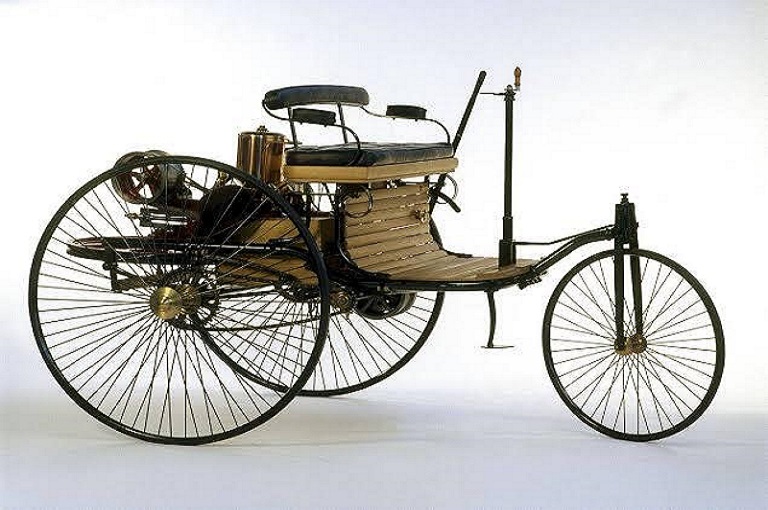
In 1885, Karl Benz completed his revolutionary three-wheeled automobile, known as the Benz Patent-Motorwagen.
Unlike traditional horse-drawn carriages, this vehicle was designed from the beginning as a motorised automobile. Its engine, chassis and driving mechanism were integrated into a single vehicle.
The Motorwagen featured a single-cylinder, four-stroke petrol engine that initially produced approximately 0.75 horsepower.
Its key specifications included:
- Engine type: Single-cylinder, four-stroke petrol engine
- Engine displacement: Approximately 954 cc
- Power output: Around 0.75 HP
- Number of wheels: Three
- Maximum speed: Approximately 16 kmph
- Seating capacity: Two people
- Engine location: Rear-mounted
The vehicle had one front wheel and two rear wheels. Unlike modern cars, it did not feature a conventional steering wheel. Instead, Benz developed a specialised steering mechanism to control the front wheel.
The automobile also incorporated several important mechanical innovations, including an ignition system, carburettor, cooling arrangement and engine-driven transmission.
Although its performance was modest compared with modern vehicles, the Motorwagen represented a revolutionary engineering achievement.
January 29, 1886: The Historic Patent That Changed Automotive History
One of the most important moments in Karl Benz’s career came on January 29, 1886.
On this date, he submitted a patent application for his petrol-powered motor vehicle. The invention received German patent number 37435.
This document became one of the most significant milestones in the history of automobiles.
The patent established the technical foundation of Benz’s motorised vehicle and demonstrated that an automobile powered by an internal combustion engine could be developed as a practical machine.
In July 1886, the vehicle was publicly demonstrated, attracting attention and curiosity.
Initially, many people were sceptical about the idea of a motorised carriage. They were accustomed to horses and traditional transportation methods and found it difficult to imagine travelling in a vehicle powered entirely by an engine.
However, Benz’s invention gradually began changing public perceptions.
Today, the original patent is recognised as an important historical document and is included in UNESCO’s Memory of the World Register.
Bertha Benz’s Historic 106-Kilometre Journey Proved the Car’s Potential
Developing the automobile was only the first challenge. Karl Benz also needed to demonstrate that his invention could be used for practical, long-distance transportation.
This is where his wife, Bertha Benz, made history.
On August 5, 1888, Bertha secretly took the Motorwagen on a journey with her two sons, Richard and Eugen. She travelled from Mannheim to Pforzheim in Germany, covering approximately 106 kilometres.
At the time, there were no modern petrol stations or automobile repair centres along the route. The journey presented several technical and practical challenges.
When the vehicle needed fuel, Bertha purchased ligroin, a petroleum-based solvent used as fuel for the engine, from a pharmacy.
She also dealt with several mechanical problems during the journey. When the fuel line became blocked, she used a hatpin to clear it. She also approached a cobbler to improve the braking system by adding leather to the brake shoes.
Her determination and practical problem-solving skills helped complete the journey successfully.
This historic trip demonstrated that the automobile was capable of travelling long distances and was not merely an experimental machine.
Bertha’s journey also attracted considerable attention and helped establish public confidence in Karl Benz’s invention.
1894: Karl Benz Introduced the Benz Velo for Commercial Buyers
Karl Benz understood that the future of automobiles depended not only on technological innovation but also on making vehicles practical and commercially accessible.
In 1894, his company introduced the Benz Velo, one of the early lightweight automobiles designed for commercial production.
The vehicle featured improvements in design and practicality compared with earlier models.
The Benz Velo was particularly important because it represented a shift from experimental automobile manufacturing towards commercial vehicle production.
Between 1894 and 1901, approximately 1,200 units of the Benz Velo were manufactured.
Its commercial success demonstrated that automobiles could become products for customers rather than remaining limited to engineering experiments.
This development also encouraged other manufacturers to enter the growing automobile market.
1926: The Merger That Led to Mercedes-Benz
Karl Benz was not the only German engineer contributing to the development of automobiles. Gottlieb Daimler and his associate Wilhelm Maybach were also working on advanced petrol engines and motorised vehicles.
While Benz developed the Patent-Motorwagen, Daimler and Maybach made important contributions to high-speed petrol engines and automobile technology.
For many years, the two companies operated independently.
However, in 1926, Benz & Cie. and Daimler-Motoren-Gesellschaft merged to form Daimler-Benz AG.
This merger established the foundation of the Mercedes-Benz automotive brand, which would eventually become one of the most recognised names in the global automobile industry.
Karl Benz remained interested in engineering and automobiles during his later years.
He passed away on April 4, 1929, in Ladenburg, Germany. His contributions, however, continued to influence automobile development long after his death.
How Karl Benz’s Invention Transformed the Global Automobile Industry
Karl Benz’s invention was much more than a three-wheeled vehicle with a small engine. It helped establish the foundation for modern motorised transportation.
His work encouraged engineers and manufacturers to develop more powerful engines, improved steering systems, better braking mechanisms and more reliable vehicles.
The automobile gradually became an important part of everyday life.
Its influence extended across several industries.
1. Development of Personal Transportation
Motor vehicles gradually reduced people’s dependence on horse-drawn carriages and opened new possibilities for independent travel.
2. Growth of the Automobile Manufacturing Industry
Benz’s invention helped inspire the development of commercial automobile manufacturing, creating opportunities for engineering companies and vehicle manufacturers.
3. Improvements in Engine Technology
The development of internal combustion engines encouraged continuous improvements in fuel efficiency, performance and reliability.
4. Expansion of Road Transportation
Motor vehicles transformed the movement of people and goods, contributing to the expansion of road networks and transport services.
5. Foundation for Modern Automotive Technology
The early automobile industry eventually paved the way for petrol, diesel, hybrid and electric vehicles.
Modern cars now feature advanced driver assistance systems, automatic braking, airbags, digital connectivity and sophisticated engine management technologies.
Although today’s vehicles are dramatically different from Benz’s original Motorwagen, the basic concept of a self-propelled automobile remains central to the industry.
Conclusion: How a 0.75 HP Engine Started an Automotive Revolution
Karl Benz’s story demonstrates how a small engineering invention can transform the future of an entire industry.
His three-wheeled Motorwagen, developed in 1885, was far from the powerful and technologically advanced cars we see today. It had a modest engine, limited speed and a simple mechanical design.
Yet, it established an important foundation for the development of practical petrol-powered automobiles.
His engineering vision, combined with Bertha Benz’s financial support and historic long-distance journey, helped turn an experimental invention into a revolutionary transportation concept.
Today, as the automobile industry moves towards electric mobility, autonomous driving and sustainable transportation, the contribution of Karl Benz remains deeply significant.
The journey of modern automobiles began with a machine that produced just 0.75 horsepower and had only three wheels. Karl Benz did not simply build a car; he helped change the way the world travels.
About The Author