Jadeja-Sundar’s century bravery made test draw, series still ahead with England 2-1
The Manchester Test: The Early Struggle and Pressure
On Sunday, July 27, 2025, during the fourth Test at Old Trafford in Manchester, England posted a massive 669 in their first innings, which ranks among their top five highest Test totals . Facing a daunting 311-run deficit, India began their second innings shakily, losing two wickets without scoring any runs—technically at 0 for 2 . The early dismissal of Yashasvi Jaiswal further compounded the crisis, putting India under immense pressure .
Gill and Rahul Provide a Turning Point
From this precarious position, captain Shubman Gill (103) and KL Rahul (90) steadied the ship. Their crucial 188-run partnership for the third wicket during the second and third sessions of day four shifted momentum in India’s favor. Gill, playing with remarkable grit, scored at a strike rate of 43.3, while Rahul matched with 39.13 . Gill’s century was his fourth of the series, matching feats previously only achieved by legends like Don Bradman and Sunil Gavaskar . Rahul fought a composed innings but was dismissed just before lunch, raising the score to 222/4 and once again testing India’s resilience .
Jadeja–Sundar Heroics: Turning Fear into Fortitude
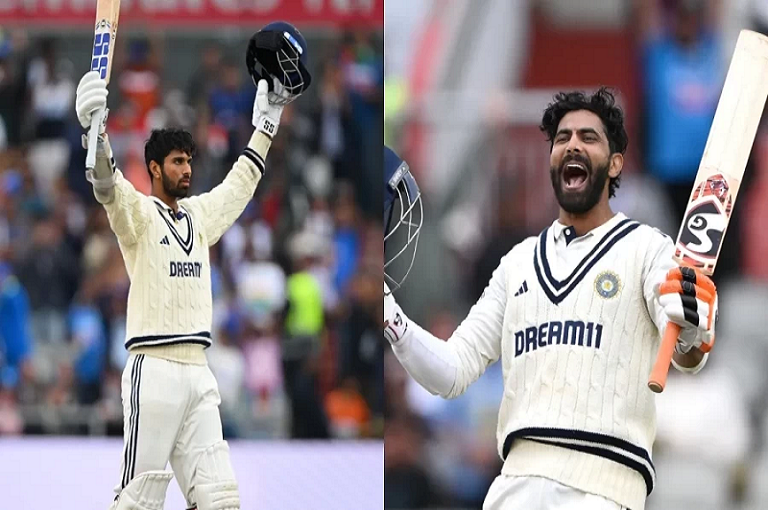
Following Rahul’s dismissal, the responsibility fell on Ravindra Jadeja (107)* and *Washington Sundar (101)**. Together, they forged an astounding 203‑run unbeaten partnership, effectively rescuing India from defeat and securing a draw . Jadeja’s resilience was aided by a dropped catch early on, which he capitalized upon magnificently . As evening progressed, no further wickets fell, and India closed the innings at 425/4, ensuring the match ended in a draw . Frustrated and toiling, England simply ran out of ideas against India’s dogged resilience .
More Than a Draw: A Mental Victory
While the match ended without a result, for India it was nothing short of a mental triumph. England’s hopes of sealing the series fell flat as the Indian quartet refused to yield under pressure . In the final hour, England captain Ben Stokes offered a handshake to end the game early—but India declined, determined to let Jadeja and Sundar complete their centuries. The gesture sparked controversy, drawing criticism for England’s perceived unsportsmanlike behavior . Gill defended the decision, stating that a Test hundred is a milestone that deserves respect and completion .
The Quartet Who Left an Indelible Mark
Shubman Gill
A courageous captain’s century (103)—his fourth of the series—and a leadership example against adversity
KL Rahul
Played a disciplined and composed innings of 90, forging the key partnership with Gill under immense pressure .
Ravindra Jadeja
Dug in after a missed chance to score an unbeaten 107*, applying patience and technical skill when it mattered most .
Washington Sundar
Played his debut Test century (101*), sharing the monumental unbroken 203-run partnership to steer India to safety .
Looking Ahead: The Oval Beckons
With the series now poised at 2–1 in England’s favour, the decisive fifth Test begins on 31 July at The Oval, London. India heads into it with renewed confidence and momentum, having shown they can battle back even from the brink . Moreover, team management is closely monitoring key players’ fitness—Rishabh Pant is ruled out, while Jasprit Bumrah’s availability remains under consideration . England captain Ben Stokes, despite soreness and a heavy workload, is expected to lead his side in the final match as well . The Oval Test promises a high-stakes showdown, with both teams managing injuries, fatigue, and form as they vie for a decisive conclusion to this thrilling series.
Conclusion: An Iconic Escape Etched in Memory
This Test will be remembered not just as another draw, but as a showcase of courage, character, and clutch performance.
The combined efforts of Gill, Rahul, Jadeja, and Sundar exemplified brushstroke brilliance under duress.
Facing a formidable English total, they refused to crumble and instead turned it into a defining moment of defiance.
In that context, the draw transcended cricketing result—it became a psychological victory as powerful as any win.
Fans will long recall the intensity, emotion, and skill of this display. For India, the result was a draw—but mentally, they emerged unquestionably stronger.
About The Author